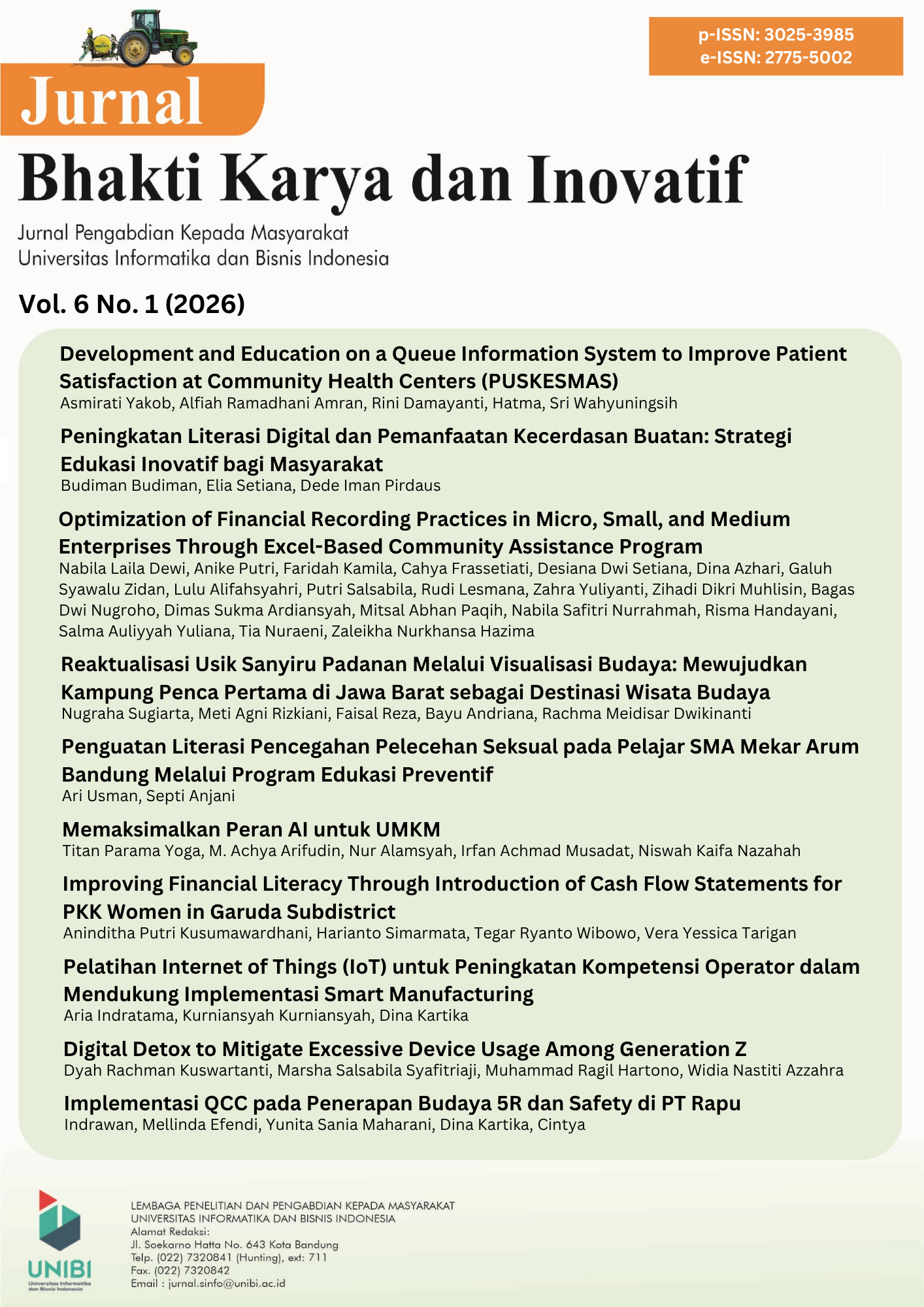
Peningkatan Literasi Digital dan Pemanfaatan Kecerdasan Buatan: Strategi Edukasi Inovatif bagi Masyarakat
DOI:
https://doi.org/10.37278/bhaktikaryadaninovatif.v6i1.1360Keywords:
Digital Literacy, Artificial Intelligence, Community Education, Innovative TechnologyAbstract
This Community Service Activity aims to improve the digital literacy of the people of Tunggilis Village through education on Artificial Intelligence (AI) technology and its application in everyday life. The problems faced are the low level of understanding of digital technology and AI among the community, as well as a lack of awareness of digital ethics. The method used is a participatory approach involving workshops, interactive discussions, and simulations of AI technology use, such as Google Assistant and Face ID. The results of the activity show a significant improvement in participants' understanding, with 75% of participants able to explain the basic concepts of AI after the activity, compared to only 20% before the activity. The positive impacts include increased awareness of digital ethics and the potential application of AI for local economic sectors such as agriculture and SMEs. This activity contributes to the digital empowerment of rural communities to adapt to technological developments.
References
D. Sulistyawati Handayani, R. Kaunang, S. Sondang, and I. Irwansyah, “Manfaat dan Potensi Masalah Penggunaan Kecerdasan Buatan (AI) dalam Komunikasi Publik,” Co-Value Jurnal Ekonomi Koperasi dan kewirausahaan, vol. 14, no. 12, May 2024, doi: 10.59188/covalue.v14i12.4334.
Dewi Fatimah and Muta Ali Arauf, “Akibat Penetrasi Teknologi terhadap Gaya Hidup Masyarakat Desa,” INSOLOGI: Jurnal Sains dan Teknologi, vol. 4, no. 2, pp. 199–206, Apr. 2025, doi: 10.55123/insologi.v4i2.5057.
S. Abdullah et al., Pemberdayaan Media Cyber di Era Digital. Kabupaten Agam: Yayasan Tri Edukasi Ilmiah, 2025.
I. H. Sarker, “Machine Learning: Algorithms, Real-World Applications and Research Directions,” SN Comput. Sci., vol. 2, no. 3, p. 160, May 2021, doi: 10.1007/s42979-021-00592-x.
C. Janiesch, P. Zschech, and K. Heinrich, “Machine learning and deep learning,” Electronic Markets, vol. 31, no. 3, pp. 685–695, Sep. 2021, doi: 10.1007/s12525-021-00475-2.
Kushariyadi et al., Artificial Intelligence: Dinamika Perkembangan AI Beserta Penerapannya. Jambi: PT. Sonpedia Publishing Indonesia, 2024.
G. Jagodič and M. Šinkovec, “Involvement of Artificial Intelligence in Modern Society,” International Journal of Management, Knowledge and Learning, vol. 10, Sep. 2021, doi: 10.53615/2232-5697.10.267-273.
R. Yusianto, M. Marimin, S. Suprihatin, and H. Hardjomidjojo, “Expanding and enhancing knowledge using Artificial Intelligence (AI) in the Asian agro-industrial sector,” in Digitalisation and Organisation Design, London: Routledge, 2022, pp. 226–252. doi: 10.4324/9781003163824-16.
E. Vázquez Pita, “La UNESCO y la gobernanza de la inteligencia artificial en un mundo globalizado. La necesidad de una nueva arquitectura legal,” Anuario de la Facultad de Derecho. Universidad de Extremadura, no. 37, pp. 273–302, Feb. 2022, doi: 10.17398/2695-7728.37.273.
K. R. dan T. Kementerian Pendidikan, Buku Panduan Penelitian dan Pengabdian Kepada Masyarakat. 2023.
Downloads
Published
Issue
Section
License
Copyright (c) 2026 Budiman Budiman, Elia Setiana, Dede Iman Pirdaus

This work is licensed under a Creative Commons Attribution-ShareAlike 4.0 International License.
<