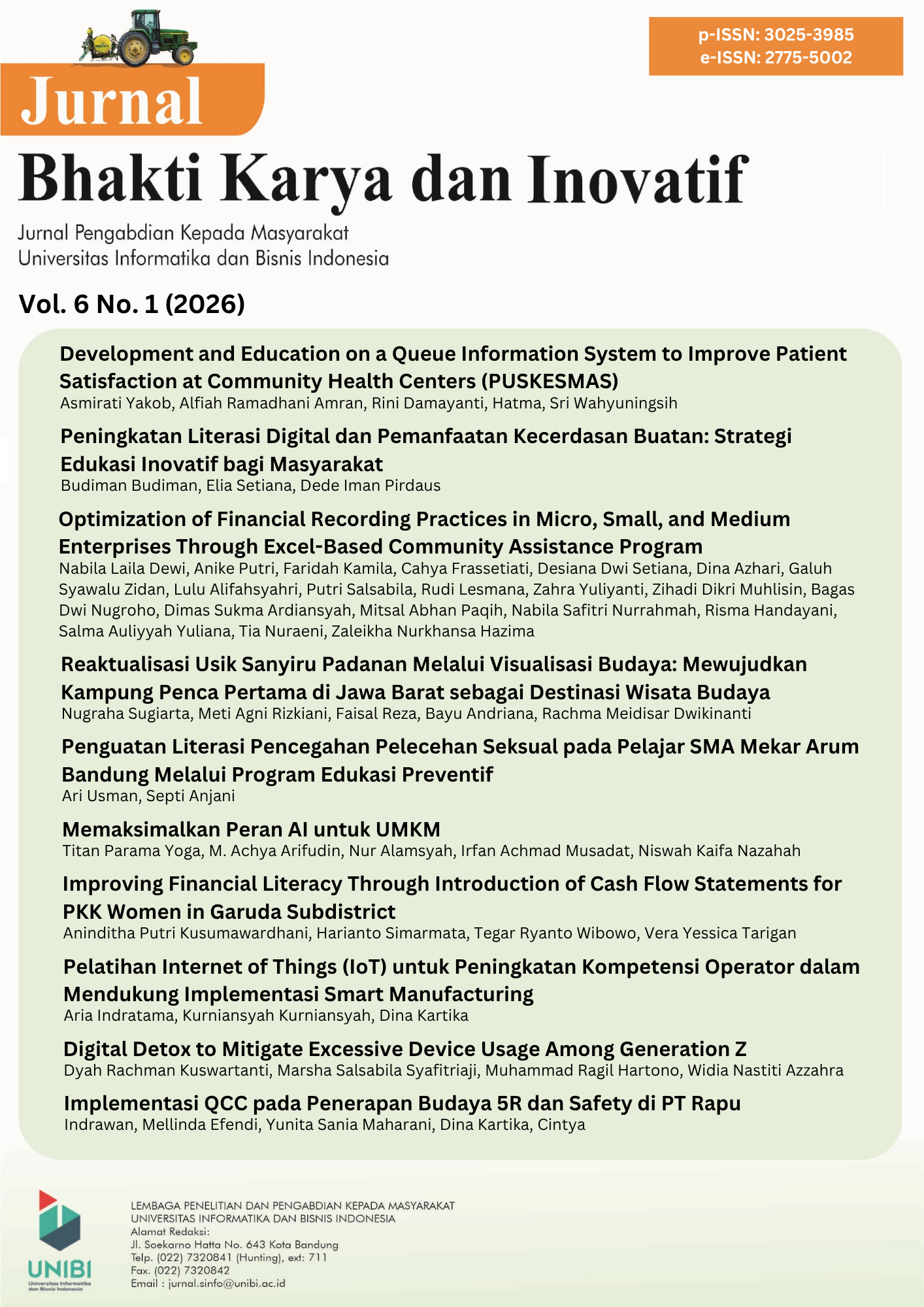
Improving Financial Literacy Through Introduction of Cash Flow Statements for PKK Women in Garuda Subdistrict
DOI:
https://doi.org/10.37278/bhaktikaryadaninovatif.v6i1.1482Keywords:
Financial Literacy, Cash Flow Statement, Community Empowerment, Financial ManagementAbstract
This community service program was designed to enhance the financial literacy of PKK women in Garuda Subdistrict, Andir District, Bandung, by introducing the concept and practice of preparing cash flow statements for household and micro‑business finances. Garuda is an urban area with dense population and heterogeneous income levels, where many households depend on informal and unstable sources of income, making structured cash flow management crucial for economic resilience. However, most PKK members had never formally prepared financial reports and tended to record income and expenses in an unstructured manner, which limited their ability to plan, save, invest, and avoid consumptive debt. The program applied a participatory action research (PAR) design combined with an asset‑based community development (ABCD) approach, engaging PKK women as active co‑learners and leveraging existing community assets such as social cohesion, local organizational structures, and ongoing PKK activities. Activities included interactive lectures on basic financial literacy, training on the structure and classification of operating, investing, and financing cash flows, guided practice using simple cash flow templates, simulations of household budgeting in the context of inflation, and motivational sessions on developing a positive financial mindset. Result that can achieved from this activity, simple tools can have meaningful effects on financial awareness with almost 90% of paticipants and self‑reflection among community members with limited prior exposure to formal financial education. This is in line with one of the goals of community service, namely financial literacy.
References
D. S. P. Koesoemasari, S. Lestari, Harsuti, M. Suryandini, D. A. Putri, M. N. Juliantika, and J. A. Putri, “Community‑Based Participatory Action Research Methodology to Improve Financial Literacy and Financial Inclusion of Women Entrepreneur,” Eduvest: Journal of Universal Studies, vol. 4, no. 10, pp. 1–12, 2024.
N. Fajarwati, “Financial Literacy and Business Management for Women Micro‑Entrepreneurs,” Journal of Community Service, vol. 3, no. 2, pp. 45–55, 2022.
I. F. N. Hamida, “Increasing Financial Literacy in Empowering Women Bead Craftsmen in Jodipan Colorful Village,” Journal of Community Development, vol. 2, no. 1, pp. 10–18, 2024.
D. S. Bela, “Asset‑Based Community Development: The Bantar Village Innovation Program,” Jurnal Manajemen Pembangunan, vol. 12, no. 2, pp. 101–116, 2024.
F. N. Asyahidda, “The Asset‑Based Community Development Approach in Village Economic Empowerment,” Socio‑Economic Empowerment Journal, vol. 5, no. 1, pp. 30–42, 2024.
Dote Pardo JS, "Financial literacy for women's empowerment in emerging countries: what can we do to overcome the current gaps?". Academia Revista Latinoamericana de Administracion, 2025. https://doi.org/10.1108/ARLA-04-2025-0116
Setyawan, W. H., Rahayu, B., Muafiqie, H., Ratnaningtyas, M., & Nurhidayah, R. (2022). Asset Based Community Development (ABCD). Angewandte Chemie International Edition, 6(11), 951-952.
N. A. Zuhriyah, “Empowering Women through Financial Literacy and Cash Flow Management,” Journal of Finance and Gender Studies, vol. 4, no. 1, pp. 20–35, 2025.
H. Bela and A. Colleague, “Asset‑Based Community Development: Leveraging Local Strengths for Sustainable Empowerment,” Engagement Journal, vol. 6, no. 1, pp. 55–70, 2023.
Hamzah, A., Febriansyah, Y., & Teguh, I. (2025). Penguatan literasi keuangan bagi ibu rumah tangga untuk mewujudkan kemandirian keuangan berkelanjutan. JAMARI: Jurnal Pengabdian Masyarakat Mandiri, 2(1), 35-44.
A. P. Kusumawardhani, "Analisis Keputusan Investasi terhadap Nilai Perusahaan PT Sido Muncul Tbk Tahun 2013-2020," Economics Professional in Action (E-Profit), vol. 3, no. 1, pp. 45-58, Feb. 2021.
Salma, N., Purnomo, R. F., Oktaria, E. T., Alie, M. S., & Silvia, D. (2023). Pelatihan literasi keuangan digital pada ibu-ibu PKK dalam pengelolaan produk UMKM Desa Wisata Pulau Pahawang Provinsi Lampung. Jurnal Pengabdian UMKM, 2(2), 98-103..
O. P. World Bank, Advancing Women’s Financial Inclusion: A Global Perspective. Washington, DC: World Bank, 2022.
Downloads
Published
Issue
Section
License
Copyright (c) 2026 Aninditha Putri Kusumawardhani, Harianto Simarmata, Tegar Ryanto Wibowo, Vera Yessica Tarigan

This work is licensed under a Creative Commons Attribution-ShareAlike 4.0 International License.
<