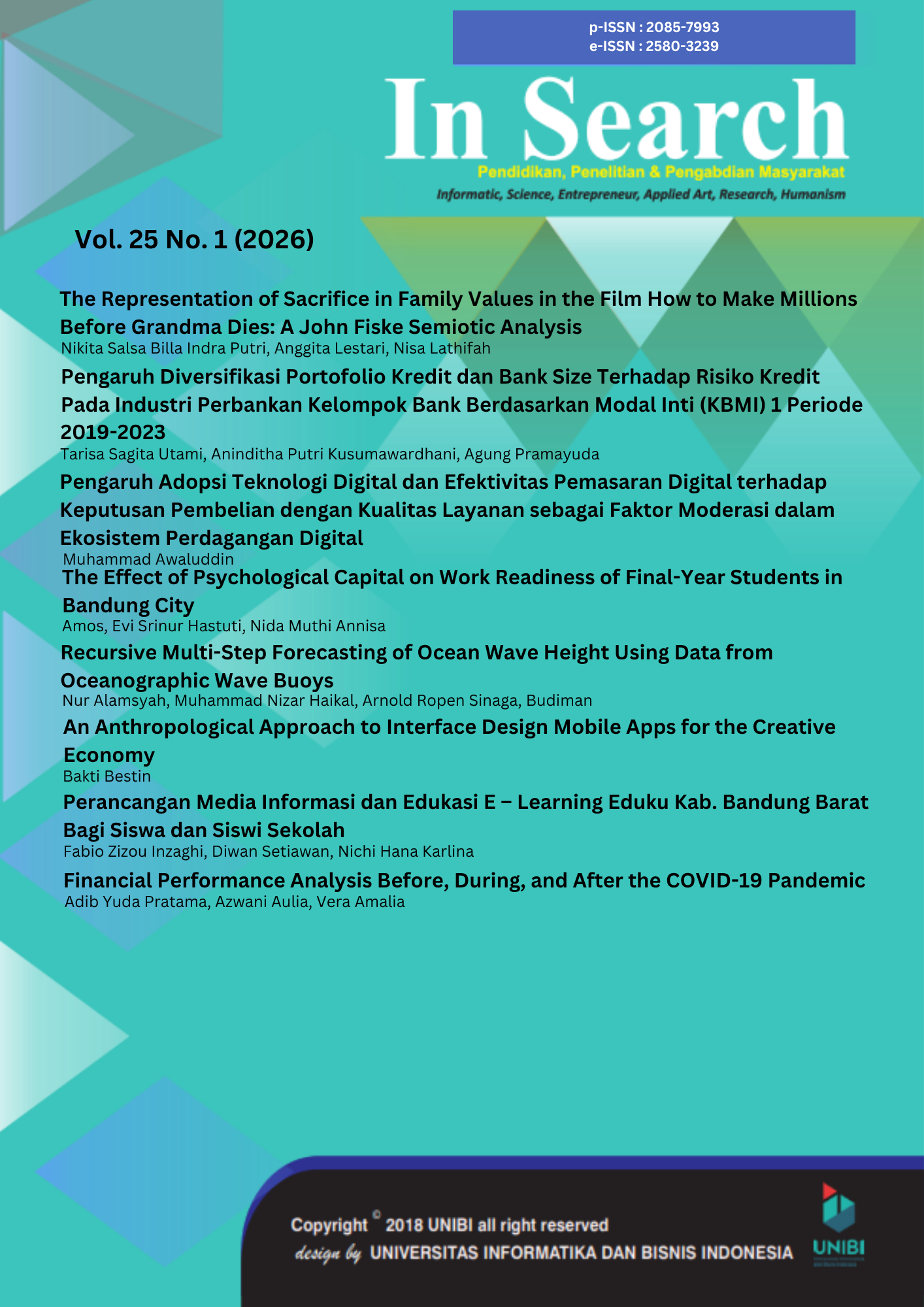
Financial Performance Analysis Before, During, and After the COVID-19 Pandemic
A Case Study of PT Pollux Investasi Internasional Tbk
DOI:
https://doi.org/10.37278/insearch.v25i1.1536Abstract
The COVID-19 pandemic has triggered an economic crisis that has disrupted the operational activities and financial stability of companies in various sectors, including property and real estate. This study aims to analyze the differences in the financial performance of PT Pollux Investasi Internasional Tbk before, during, and after the COVID-19 pandemic using a comparative quantitative approach. The financial performance is measured using profitability ratio (Return on Assets), liquidity ratio (Current Ratio), and solvency ratio (Debt to Equity Ratio) based on audited annual financial reports for the 2018–2023 period. Data were analyzed through descriptive statistics and period-to-period average comparison without inferential statistical tests. The results show that during the pandemic, profitability decreased, liquidity improved, and solvency strengthened significantly. In the post-pandemic period, the company experienced a recovery with increased profitability, stronger liquidity, and a more controlled debt structure compared to the pre-pandemic period. These findings indicate that the company successfully adapted to the crisis and achieved better financial stability after the pandemic.
References
Otoritas Jasa Keuangan, “Perkembangan Sektor Properti dan Real Estate di Indonesia Tahun 2023.” Jakarta, Indonesia, 2024.
R. Ang, “The Impact of COVID-19 on the Financial Performance of Property Sector Companies in Indonesia,” Jurnal Akuntansi dan Keuangan, vol. 25, no. 1, pp. 45–58, 2021.
Kasmir, Analisis Laporan Keuangan. Jakarta: PT RajaGrafindo Persada, 2019.
R. E. Freeman, Strategic Management: A Stakeholder Approach. Boston, MA, USA: Pitman, 1984.
Bursa Efek Indonesia, Annual Report PT Pollux Investasi Internasional Tbk 2018. Jakarta, Indonesia: Bursa Efek Indonesia, 2019..
Bursa Efek Indonesia, Annual Report PT Pollux Investasi Internasional Tbk 2019. Jakarta, Indonesia: Bursa Efek Indonesia, 2020.
Bursa Efek Indonesia, Annual Report PT Pollux Investasi Internasional Tbk 2020. Jakarta, Indonesia: Bursa Efek Indonesia, 2021.
Bursa Efek Indonesia, Annual Report PT Pollux Investasi Internasional Tbk 2021. Jakarta, Indonesia: Bursa Efek Indonesia, 2022.
Bursa Efek Indonesia, Annual Report PT Pollux Investasi Internasional Tbk 2022. Jakarta, Indonesia: Bursa Efek Indonesia, 2023.
Bursa Efek Indonesia, Annual Report PT Pollux Investasi Internasional Tbk 2023. Jakarta, Indonesia: Bursa Efek Indonesia, 2024.
Hery, Analisis Kinerja Manajemen. Jakarta: Grasindo, 2018.
J. C. Van Horne and J. M. Wachowicz, Prinsip-Prinsip Manajemen Keuangan, 13th ed. Jakarta: Salemba Empat, 2012.
S. Rahmawati and D. Prasetyo, “Comparative Analysis of Financial Ratios Before and During the COVID-19 Pandemic,” Jurnal Riset Akuntansi, vol. 12, no. 2, pp. 101–115, 2022.
A. Nugroho and F. Lestari, “Liquidity and Solvency Performance of Listed Companies During Economic Crisis,” Journal of Economics and Business, vol. 8, no. 3, pp. 210–223, 2023.
E. F. Brigham and J. F. Houston, Dasar-Dasar Manajemen Keuangan, 14th ed. Jakarta: Salemba Empat, 2019.
B. Sartono, Manajemen Keuangan: Teori dan Aplikasi, 4th ed. Yogyakarta: BPFE, 2016.
M. Saputra, “Post-Pandemic Recovery and Corporate Profitability in Indonesia,” International Journal of Finance Studies, vol. 11, no. 4, pp. 55–70, 2024.
T. Wijaya and R. Kurniawan, “Debt Policy and Capital Structure Adjustment After COVID-19,” Jurnal Manajemen dan Bisnis, vol. 14, no. 1, pp. 33–47, 2024.
A. Aulia, J. K. Siregar, and F. A. R. Aripin, “The Role of Green Culture in Generating Sustainable Economic Performance and Increasing Post-Pandemic Stock Prices Healthcare Sector in Indonesia and Singapore,” JAK (Jurnal Akuntansi) Kajian Ilmiah Akuntansi, vol. 11, no. 2, pp. 408–426, 2024, doi:10.30656/jak.v11i2.7315.
D. Pratama and R. Sari, “Effect of Liquidity and Solvency Ratios on Profitability in Indonesian Property Companies,” Jurnal Ekonomi dan Bisnis, vol. 15, no. 2, pp. 112–126, 2022.
M. Hidayat and F. Nugraha, “Financial Recovery Strategy After COVID-19 Pandemic: Evidence from Real Estate Sector,” International Journal of Finance Research, vol. 6, no. 1, pp. 44–58, 2023.
S. Putri and A. Wijaya, “Determinants of Return on Assets During Economic Crisis,” Journal of Accounting and Management, vol. 9, no. 3, pp. 77–91, 2021.
L. Kurniawan, “Working Capital Efficiency and Current Ratio Performance in Listed Firms,” Jurnal Manajemen Indonesia, vol. 18, no. 1, pp. 55–69, 2024.
T. Saputra and N. Rahma, “Capital Structure Adjustment and Debt Policy in Post-Pandemic Era,” Asian Journal of Business and Accounting, vol. 11, no. 2, pp. 101–118, 2024.
J. F. Weston and T. E. Copeland, Managerial Finance, 9th ed. Orlando: Dryden Press, 1992.
A. Gujarati and D. C. Porter, Basic Econometrics, 5th ed. New York, NY, USA: McGraw-Hill, 2009.
D. Putra and R. Lestari, “Financial Ratio Analysis in Property Companies: Comparative Study Before and After Economic Crisis,” Journal of Accounting and Investment, vol. 23, no. 2, pp. 145–158, 2022.
Downloads
Published
Issue
Section
License
Copyright (c) 2026 Adib Yuda Pratama, Azwani Aulia, Vera Amalia

This work is licensed under a Creative Commons Attribution-ShareAlike 4.0 International License.